Read the one daily signal your smartwatch can't.
You already track your sleep, glucose, HRV, and steps. Your bladder can be tracked and measured too, and it's been hiding in plain sight the whole time. Bladder behavior is a whole-body health messenger: people tend to think it's just for "symptoms," but it's so much more than that for wellness. It checks in with you multiple times a day, every day, which makes it one of the most consistent signals you own. Bladder Biometrics is the at-home kit that turns those routine messages into patterns you can actually see: how much, how often, when, and how your intake fits in. The measuring tool moves you from guessing to measuring — and the included videos, guide, and FAQ, built from years of watching what helps people spot their patterns quickly, mean you're never left staring at a sheet of numbers wondering what to do with it.
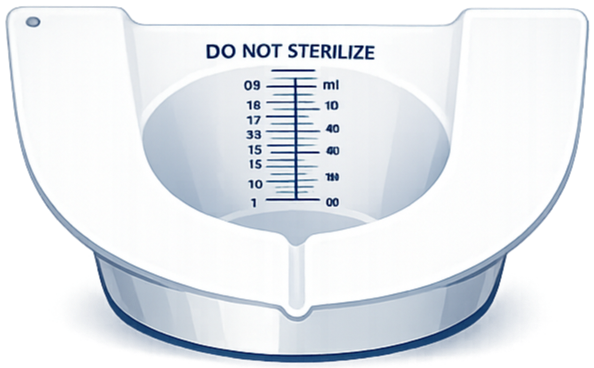
- ✓ A precision measuring tool marked in oz and mL, with live visual feedback: you see the number directly, no app estimating it for you.
- ✓ The Bladder Log: a 2–3 day at-home logging method, designed and taught by a urologist — full biometrics, not a symptom diary: intake, output, timing, day and night.
- ✓ Three guided videos walk you through the Log, from recording data to reading your patterns. Start in minutes and learn your own bladder, independently — wellness like this doesn't have to be gated.
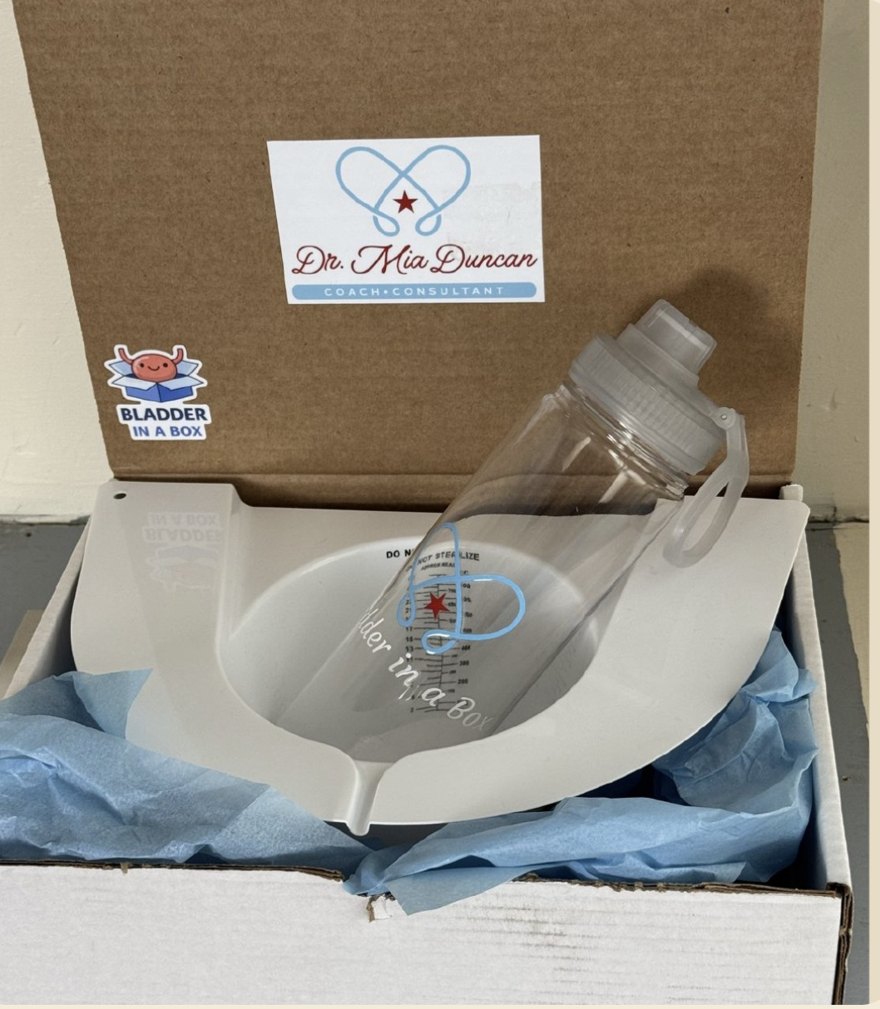
- ✓ A 27 oz reference water bottle so your intake numbers give context to your output — because full biometrics includes both, and no tracker or diary captures that.
Every trip to the bathroom is a message. You’ve just been deleting them unread.
Your bladder interrupts throughout the day so you can empty. But knowing how much, how often, and when is what converts something that feels like junk mail into a clear record of your own intake, output, and timing — day and night. Think of it as your urinary inbox: easier to read than HRV or oxygen saturation from wearables, more frequent than a lab draw, and free of charge. It's one of your body's most audible bio-messages!
The catch is the same one behind every measurement. A hand on the forehead gives you a feeling; a thermometer gives that feeling a number. This kit is the thermometer for your bladder, and it doesn't stop at measuring: the Log organizes your numbers into a 24-hour picture, and the Wellness Guide gives you general reference information to compare against — so you can make self-directed fluid and habit adjustments if needed. It measures your output directly, where smart toilets and apps estimate; you can even use it to check how accurate your app really is.
How Much
How Often
When
Why
Most of Your Bladder's Signals Live Underwater
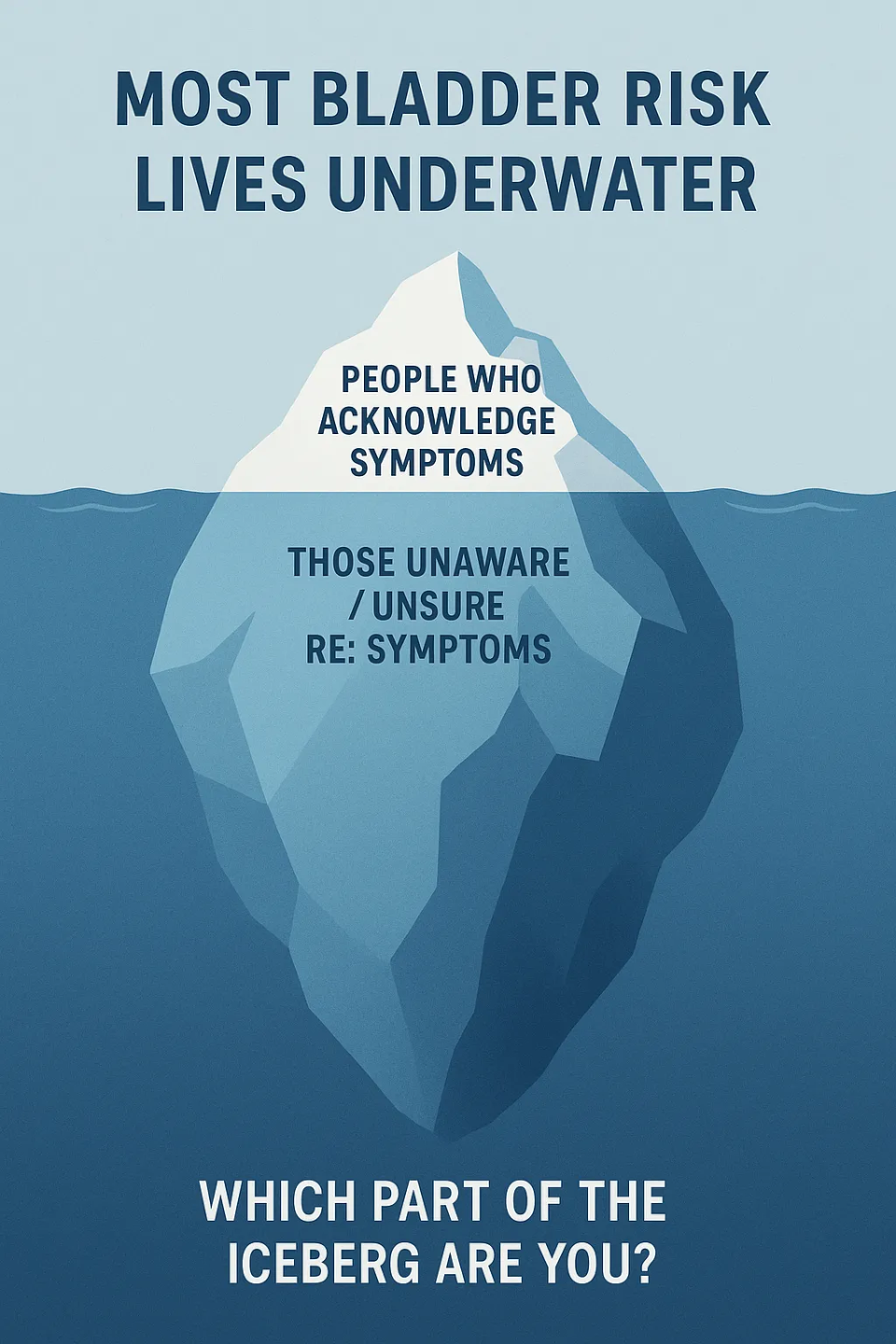
Start with the biggest part of the iceberg, underwater. Type 1 is the health-curious: no bladder story, no signals to speak of — optimizers, or at least health-conscious, measuring to know their normal the way healthy people wear a CGM. Type 2 is the far larger "probably fine" group: everything feels explained, so nothing has ever been measured — the ones who've quietly rearranged a little of their life without naming why. The visible tip, type 3, is the small group who notice symptoms; the iceberg shows where they sit.
You don't measure your blood pressure because something's wrong. You measure to be proactive, because a number you can see beats a feeling you can ignore or changes that are silent. The bladder deserves the same seat at the table as CGM, HRV, and VO₂ max — and almost no one has given it one.
Which part of the iceberg are you? The kit helps you explore that on your own — with guidance built in.
A Complete Bladder Biometrics Kit.
No Appointment, No Lab. No Jargon
Welcome Video
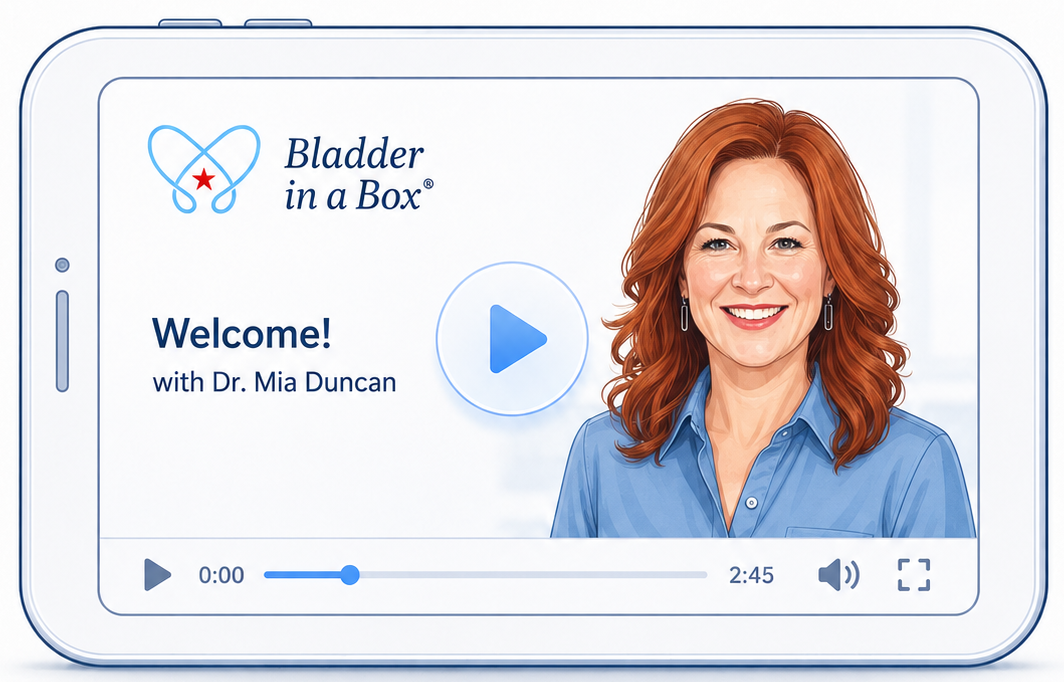
Scan the card inside the box and Dr. Duncan walks you through the whole idea — why the bladder is worth reading, how to write it down and recognize your patterns in plain language.
How-To-Video
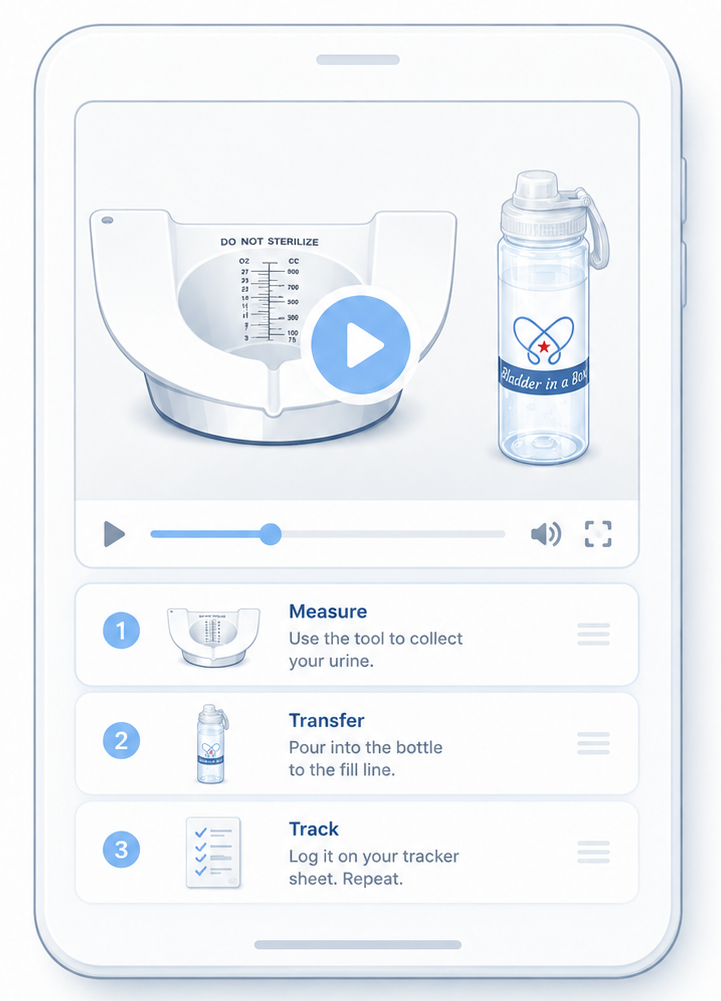
A short, friendly walk-through of the tracker so there’s nothing to figure out. You’ll be logging within minutes of opening the box.
Tracking Sheet
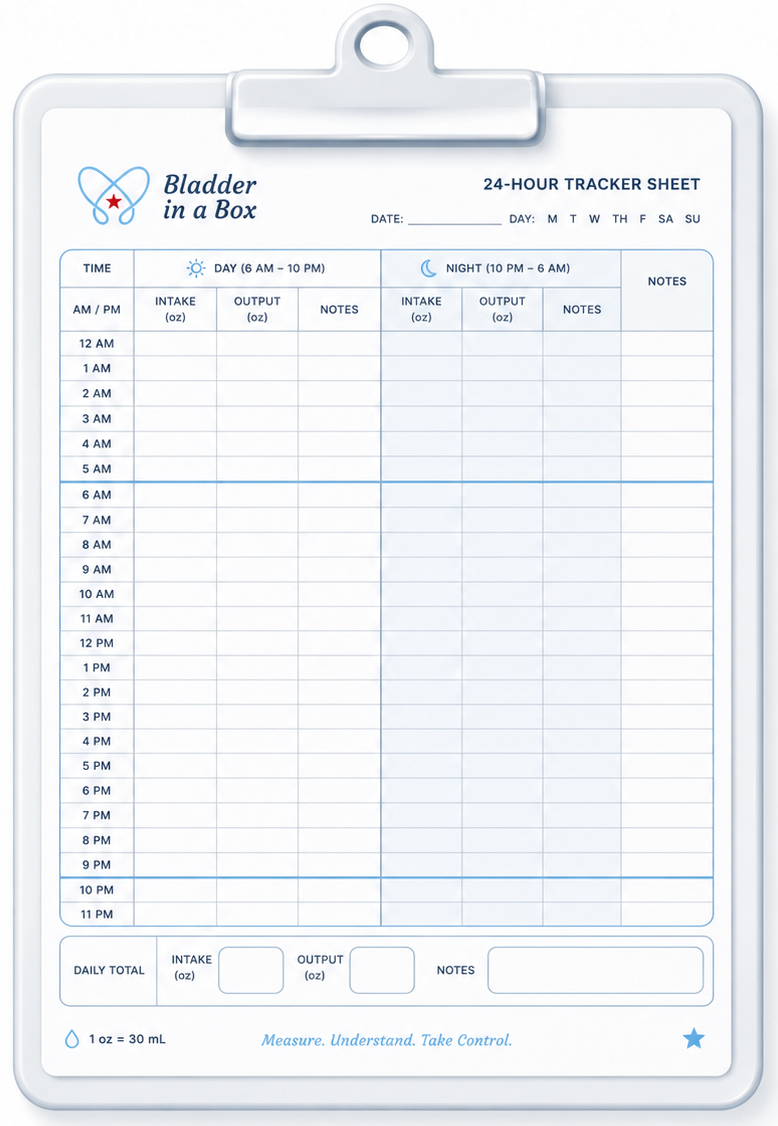
One page that becomes a day in your life — intake, output, timing, day vs. night. Even an untrained eye can scan it and see the pattern. The video guide helps you with recognition.
Measuring Tool
A precision collection tool graduated in ounces and milliliters — the foundation of the kit. Reusable, easy to clean, and the reason your data is real instead of your best guess.
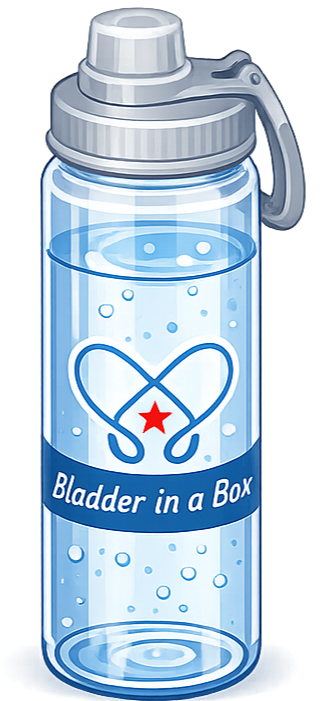
Reference Water Bottle
A branded 27 oz bottle that turns “I drink plenty” into an actual number, so your intake column means something. Sometimes people learn it’s too much fluid-that’s a thing!
The Wellness Guide
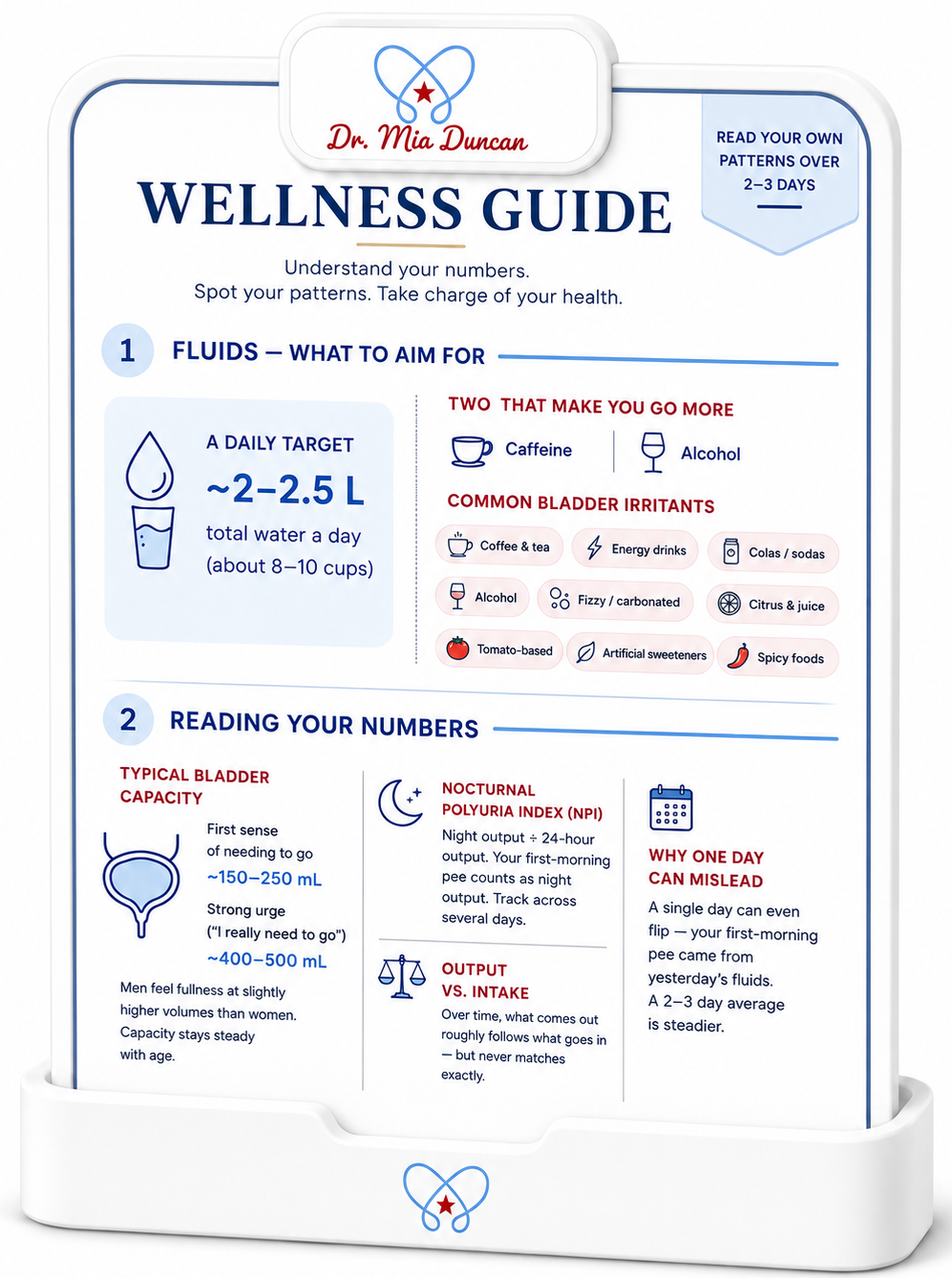
A physician-written reference grounded in published research — general information on hydration, common bladder irritants, and how to guide your own 2–3 day patterns.
Built like a gift.
It arrives in a recyclable box, wrapped in tissue, with a mascot that makes the bladder feel approachable. Because decoding your bladder's messages with biometrics is part of your whole-body health picture. A tool you'll keep, like a thermometer: recheck your baseline yearly, or whenever you're curious.
Three Days. Three Steps.
One Clear Picture.
Measure
Pick a day or two when you're close to home, and use the tool and the bottle to record what goes in and what comes out. One day is good, two is better, three is best — for most people, two does it. Then repeat whenever you like; many make it a yearly check-in.
Map
Your entries fill the grid into a 24-hour map — separating daytime from night, intake from output, signal from noise.
Recognize
Scan your grid against the general reference information in the Wellness Guide. And it's more than day-versus-night: during your biometric logging you also tune in to how each empty feels and how that matches the volume you measured. A feeling can be explained away; a few days of real numbers either back you up or give you something specific to ask your own clinician about. Either way, you leave with your baseline instead of a guess.
Three People Reach for This Kit. You’re Probably One.
The same way healthy people, prediabetics, and diabetics all use a CGM, bladder biometrics isn't only for people with a problem. (Our bladder typing is unique because it's the only system that includes healthy people and their bladders — while leaving room for those who identify with having signals. It's our own shorthand for who reaches for this kit, not a medical classification or diagnosis.)
You track everything else
Smart watch on, glucose curious, deep in the longevity conversation. This is the data point your stack is missing — and one almost no one around you is measuring. You want to know what your normal is, and the kit gets you there.
Everything feels explained
Things feel generally fine. If anything pops up, it's mild, or it's the coffee, or the big glass of water at dinner. Maybe a 2 a.m. trip you've stopped counting. When every signal has an easy explanation, nothing ever gets measured. That's exactl y when a baseline is worth the most — and it's where most people live.
You’ve started to go beyond wondering and acknowledge you’re seeing shifts in the bladder
You leave the movie to find a bathroom and your friends don’t. You might skip happy hour and you dread airplane travel and its seatbelt signs. You’d rather understand the pattern now than keep explaining it away.

"I spent a career operating on bladder problems that got bad because no one helped people pay attention early. The system only steps in once your quality of life is already suffering; everyone before that point is invisible to it. And everyone, at every age, deserves bladder intel. For years, people have told me their bladder signals started in childhood. I built this kit so you could start reading yours long before any of that, on your own terms."
Dr. Mia Duncan
The Things People Ask Before They Buy
Is this a medical test or diagnosis?
Do I need to have symptoms to use it?
Is it complicated or unpleasant?
Is this just for women, or for older people?
Is it actually private?
Shipping & returns?
Your Bladder Has Been Talking. Start Reading It.
One box. A few days. A signal you’ll never un-see — and a clearer picture of your whole-body health to take wherever you go next.
Buy Now — $5930-day returns on unopened kits · ships in 2–3 days · not a subscription
Dr. Mia Duncan
Physician-led Coaching · Built on the Health Portfolio
A note on what this is. Bladder Biometrics Kit is an educational self-tracking bladder biometrics kit. It is not a medical device, diagnostic test, or substitute for professional medical care, diagnosis, or treatment. Measurements are for pattern recognition and personal awareness only. The bladder biometrics kit and its content are private and independent of insurance networks. If you have symptoms or concerns, consult a qualified clinician. © 2026 Dr. Mia Duncan. All rights reserved.